Pseudo Codes & Pascal Codes Part 1
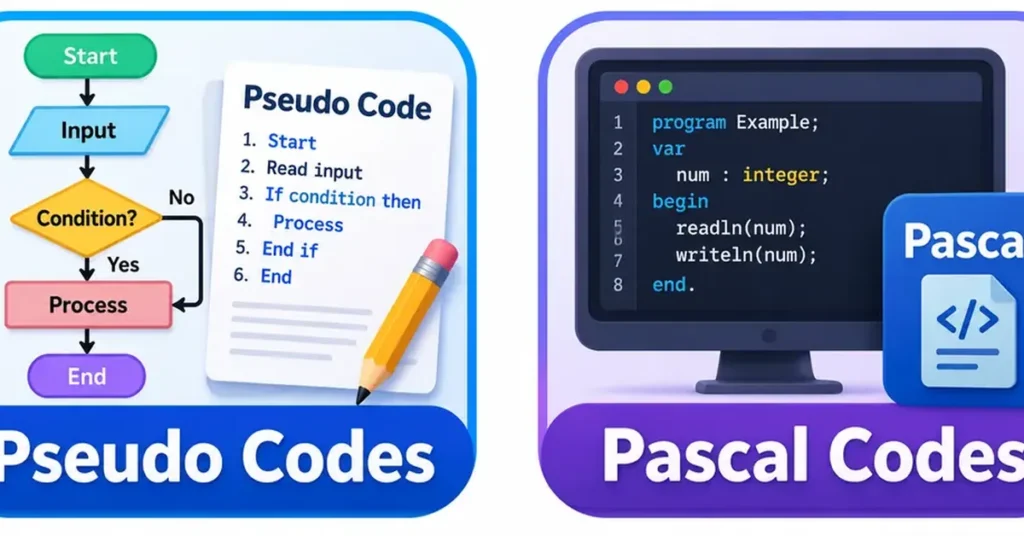
Grade 11 ICT Lesson 01 – Sequence and Pseudocode Worksheet
Welcome to Grade 11 ICT Lesson 01, designed for students studying Information and Communication Technology (ICT) in Sri Lanka. This lesson introduces the basic concepts of programming, algorithms, and sequence. Students can use this worksheet to practise writing instructions in the correct order and improve their problem-solving skills.
What Is Sequence in Programming?
Sequence is one of the fundamental concepts in programming. It means executing instructions one after another in a specific order. Each instruction is performed according to the order defined in an algorithm or program.
For example, calculating the total of two numbers involves entering the numbers, adding them together, and displaying the result. These steps must follow the correct sequence to produce the expected output.
Understanding sequence is essential before learning other programming structures, such as selection and repetition.
Pseudocode 10 Questions with Answers
This worksheet provides Pseudocode 10 questions with answers to help Grade 11 students understand basic programming concepts. The exercises focus on writing pseudocode using simple, logical instructions.
Students can practise identifying inputs, performing calculations, processing information, and displaying outputs. These activities help develop logical thinking and prepare learners for more advanced programming lessons.
Try answering all ten questions independently before checking your answers. This approach helps you identify mistakes and understand how pseudocode represents the steps of a solution.
Grade 11 ICT Programming Worksheet – Download PDF
Are you looking for a Grade 11 ICT worksheet for schoolwork, homework, or examination revision? You can download the PDF worksheet available on this page and use it for your studies.
The downloadable worksheet is suitable for individual practice, classroom activities, and ICT revision sessions. Save the PDF to your computer or mobile phone so you can practise the questions whenever you need.
Download Worksheet
Click the Download Worksheet link or button provided on this page to access the PDF. Complete the exercises carefully and review your answers to strengthen your understanding of sequence and pseudocode.
- Write a Pseudo code & Pascal code to find the sum of two numbers.
Begin

     Input no1 and no2

     Total = no1 + no2

     Print Total

End
Program No01(input,output);

Var no1,no2,total:integer;

Begin

     write('Input Number1: ');

     readln(no1);

     write('Input Number2: ');

     readln(no2);

     total:=no1+no2;

     writeln('Total is ',total);

     readln;

End.
2. Write a Pseudo code & Pascal code to find the area of rectangle.
Begin

      Input length and width

      Area = length * width

     Print Area

End
Program No02 (input,output);

Var length,width,area:integer;

Begin

     write('Input Length: ');

     readln(length);

     write('Input Width: ');

     readln(width);

     area:=length*width;

     writeln('Area is ',area);

     readln;

End.
3. Write a Pseudo code & Pascal code to find the perimeter of rectangle.
Begin

   Input length and width

   Perimeter = 2 (length +

   width)

   Print Perimeter

End
Program No03 (input,output);

Var length,width,perimeter:integer;

Begin

     write('Input Length: ');

     readln(length);

     write('Input Width: ');

     readln(width);

     perimeter:=(length*2) +(width*2);

     writeln('Perimeteris ',

     perimeter);

     readln;

End.
4. Write a Pseudo code & Pascal code to find the sum & average of two numbers.
Begin

   Input no1 and no2

   Total = no1 + no2

   Average = Total / 2

   Print Total , Average

End
Program No04 (input,output);

Var no1,no2,total:integer;

avg:real;

Begin

     write('Input Number1: ');

     readln(no1);

     write('Input Number2: ');

     readln(no2);

     total:=no1+no2;

     avg:=total/2;

     writeln('Total is ',total);

    writeln('Average is ',avg);

    readln;

End.
5. Write a Pseudo code & Pascal code to find the perimeter of square.
Begin

   Input length

   Perimeter = 4 * length

   Print Perimeter

End
Program No05 (input,output);

Var length,perimeter:integer;

Begin

     write('Input Length: ');

     readln(length);

     Perimeter:=4*length;

     write('Perimeter is ',perimeter);

    readln;

End.
6. Draw a Pseudo code & Pascal code to find the area of square.
Begin

   Input length

   Area = length * length

   Print Area

End
Program No06 (input,output);

Var length,area:integer;

Begin

     write('Input Length: ');

     readln(length);

     area:=length* length ;

     writeln('Area is ',area);

     readln;

End.
7. Write a Pseudo code & Pascal code to find the sum & average of three numbers.
Begin

   Input no1,no2 and no3

   Total=no1 + no2 + no3

   Average = Total / 3

   Print Total , Average

End
Program No07 (input,output);

Var no1,no2,no3,total:integer;

avg:real;

Begin

     write('Input No1: ');

     readln(no1);

     write('Input No2: ');

     readln(no2);

     write('Input No3: ');

     readln(no3);

     total:=no1+no2+no3;

     avg:=total/3;

     writeln('Total is: ',total);

     writeln('Average is: ',avg);

     readln;

End.
8. Write a Pseudo code & Pascal code to convert Fahrenheit degrees to Celsius degrees.
Begin

   Input Fahrenheit ( f )

   Celsius = 5 /9 * ( f – 32 )

   Print Celsius

End
Program No08 (input,output);

Var f,c:real;
Begin
   write('Input Fahrenheit degrees: ');

   readln(f);

   c:=5/9*(f-32);

   writeln('Celsius Degree is ',c);

   readln;

End.
9. Write a Pseudo code & Pascal code to finding the value of product by giving 5% discount.
Begin

Input Amount ( A )

    Bill value = Amount –

    (Amount * (5 / 100))

Print Bill value

End
Program No09 (input,output);

Var amount,total:real;

Begin

   write('Input Amount: ');

   readln(amount);

   total:=amount-(amount*5/100);

   writeln('Bill Value is: ',total);

   readln;

End.
10. An Electric Meter Reader prepare the electricity bill by subtracting the current reading from the past reading & multiplying it by unit price. Draw a flow chart and write a Pseudo code & Pascal code to solve this problem.
Begin

    Input Past Reading (PC) ,

    Current Reading (CR) ,

    Unit Price (P)

    Amount = ( CR – PR ) * P

    Print Amount

End
Program No10 (input,output);

Var pr,cr,units,total,price:integer;

Begin

   write('Input Past Reading: ');

   readln(pr);

   write('Input Current Reading: ');

   readln(cr);

   write('Input Unit Price: ');

   readln(price);

   units:=cr-pr;

   total:=units*price;

  writeln('Bill Value is: ',total);

  readln;

End.